Last reviewed: 22 July 2026. This article covers NHS pharmaceutical services in England; different arrangements apply elsewhere in the UK.
For pharmacists and investors considering an online model, an NHS distance selling pharmacy can appear to offer a route into the NHS market without operating a patient-facing high-street pharmacy. However, an NHS distance selling pharmacy is not simply an online pharmacy. It is an NHS pharmacy operating under specific market entry rules and terms of service.
The short answer is that new NHS distance selling pharmacy applications are no longer permitted in England. The DSP market entry exemption closed on 23 June 2025. This did not ban online pharmacies, close existing DSPs, or prevent every form of NHS pharmacy application, but it changed the options available to new applicants.
Can I still apply to open a new NHS distance selling pharmacy?
No. Primary Care Support England confirms that, from 23 June 2025, no new applications for distance selling premises can be accepted under the NHS (Pharmaceutical and Local Pharmaceutical Services) Regulations 2013.
An application submitted on or before 22 June 2025 can still be determined under the previous rules. A DSP decision appearing after the deadline may therefore relate to a transitional application; it does not mean that the route has reopened.
The phrase “DSP licence” is sometimes used informally, but the key issue is whether the applicant can be included in the NHS pharmaceutical list in relation to distance selling premises. A new applicant cannot now use the former DSP exemption to obtain that inclusion.
What is an NHS distance selling pharmacy?
An NHS distance selling pharmacy, often described as distance selling premises or a DSP, is a pharmacy included in an NHS pharmaceutical list subject to conditions requiring NHS pharmaceutical services to be provided at a distance. Community Pharmacy England’s DSP overview explains these continuing conditions.
Historically, the DSP route was an exception to the usual NHS pharmacy market entry test. A new DSP did not have to show that it met a need identified in the local Pharmaceutical Needs Assessment. In return, it had to make Essential services available to anyone in England who requested them and provide those services without face-to-face contact at the pharmacy premises.
This is different from a private online pharmacy. “Online pharmacy” describes how a service is offered, while “DSP” is a particular NHS regulatory status. A traditional community pharmacy can also provide online ordering or delivery without becoming a DSP.
Why did the DSP application route close?
The 2025 amendment regulations removed the market entry exemption for new DSPs. In its explanatory memorandum, the Department of Health and Social Care said the exemption had allowed DSPs to establish without reference to local pharmaceutical need and then provide local face-to-face services.
Closing the exemption was intended to restore consistency between applicants seeking to enter the NHS market. It was not a general ban on digital pharmacy services: private online and hybrid models remain possible.
What can existing NHS DSPs still do?
Existing DSPs can remain on the pharmaceutical list and continue providing NHS pharmaceutical services, provided they comply with their terms of service. Applications involving change of ownership or relocation also remain possible, subject to the relevant tests and approvals.
The national obligation continues: procedures must support uninterrupted Essential services during opening hours for anyone in England who requests them, and marketing must not suggest that NHS services are limited to a particular area or patient group.
Since 1 October 2025, DSPs have not been permitted to provide Directed services (Advanced, National Enhanced and Enhanced services), face-to-face at or in the vicinity of the DSP premises. The temporary exception for on-site COVID-19 and influenza vaccinations ended on 31 March 2026. Individual Directed services may still be provided remotely or off-site only where the applicable service specification permits, with commissioner approval where required. Community Pharmacy England’s service-change guidance explains the position in more detail.
Buying an existing DSP may be possible in principle, but it is not a new DSP application. The regulatory route depends on the transaction structure: a change in the contractor’s legal identity requires NHS approval, while a share purchase involving the same contractor may instead require director or superintendent notifications and fitness information. Due diligence should cover compliance history, the prescription base, premises, delivery model, liabilities and the face-to-face restrictions.
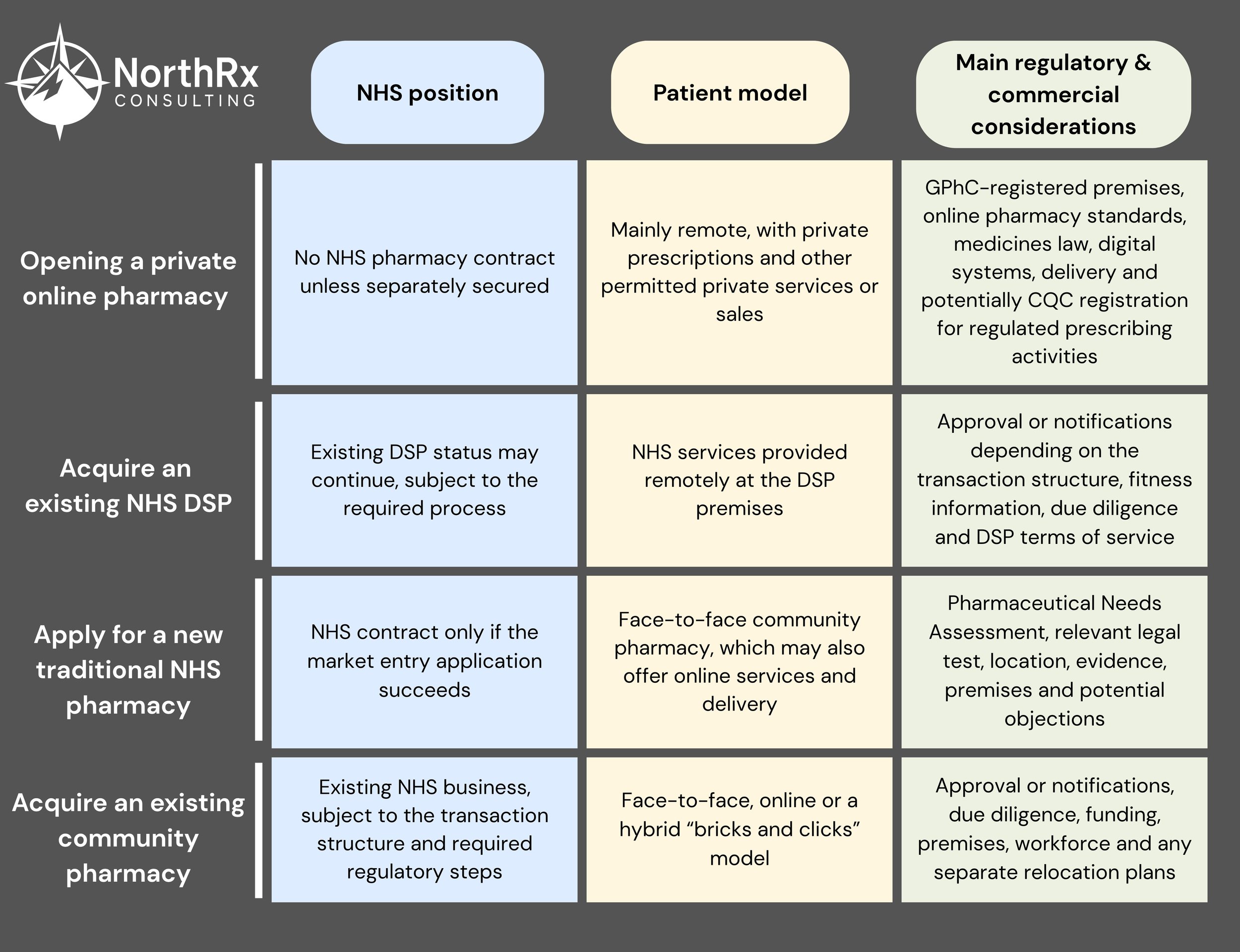
What options are available instead of a new DSP application?
The right alternative depends on whether the proposed business needs NHS dispensing income, face-to-face patient access, a national online model, or a combination of these.
Why a private online pharmacy could be a viable option
The closure of the NHS DSP exemption does not prevent a private online pharmacy from being established. This may suit an operator who wants to provide private prescription services, pharmacy medicines or other appropriate services through a digital platform without relying on an NHS contract.
Depending on the model, this can create scope to serve patients beyond one local area and develop a defined service offering. Because the business is not seeking inclusion in the NHS pharmaceutical list, the NHS market entry test does not apply.
That does not make a private online pharmacy unregulated or automatically viable. Its premises must be registered with the General Pharmaceutical Council and the service must meet the GPhC’s guidance for pharmacy services provided at a distance. Governance, staffing, website transparency, patient assessment, prescribing relationships, data security and delivery all need to be addressed. If the operator also provides online prescribing or another regulated clinical activity in England, CQC registration may be required, depending on the structure.
Commercial questions matter as much as registration. The pharmacy needs credible patient demand, sustainable pricing and control of prescribing, dispensing, marketing and delivery costs. An early feasibility review can test the model before significant expenditure is committed.
Why a traditional bricks-and-mortar pharmacy may work instead
For some applicants, a traditional community pharmacy may offer a stronger long-term model. It can provide face-to-face access, build local trust, deliver eligible NHS and locally commissioned services, and combine NHS, private and retail income. It can also add online ordering and delivery without being subject to the DSP restriction on face-to-face NHS services at the premises.
There are two broad ways to pursue this route. An applicant may acquire an existing NHS pharmacy business, subject to the regulatory steps required for the transaction, or make a new NHS pharmacy market entry application.
A new application is not granted simply because the applicant has found a suitable unit or prepared a strong business plan. Depending on the route, it may need to meet a current or future need, provide an identified improvement or better access, or offer unforeseen benefits under the Pharmaceutical Needs Assessment framework. As explained in our article on NHS pharmacy market entry applications, the case should be built around the relevant legal test and local evidence. The resulting pharmacy must operate as an ordinary patient-facing pharmacy; this is not a route to a new remote-only NHS DSP.
Property, fit-out and staffing costs may be higher, while an acquisition requires capital and careful due diligence. Even so, combining face-to-face services with digital convenience may make this the more suitable route.
Which pharmacy route is right for your plans?
There is no one size fits all approach. Before choosing a route, it is sensible to consider:
whether the business needs NHS prescription income or will be privately funded
whether patients need to attend the premises
whether the target market is local, national or both
the cost of establishing a new service compared with acquiring an existing pharmacy
the premises, staffing, technology and delivery arrangements required
the relevant NHS, GPhC, CQC and wider legal requirements
The closure of new DSP applications does not mean that an online or NHS pharmacy project must end. It means the model needs to be assessed under a different route.
Frequently asked questions about NHS DSP pharmacies
-
No. New NHS distance selling pharmacy applications have not been permitted in England since 23 June 2025. Only applications submitted on or before 22 June 2025 benefit from the transitional arrangements.
-
Yes, subject to the requirements for the proposed service. A private online pharmacy is not an NHS DSP, and GPhC premises registration alone does not allow it to dispense NHS prescriptions as an NHS contractor.
-
Potentially. The necessary approval or notifications depend on the transaction structure, and due diligence remains essential. The acquisition does not create a new DSP contract.
-
No reopening has been announced. The government previously said it would monitor patient choice, but new DSP applications remain prohibited and business plans should be based on the current rules.
-
No. Existing DSPs must provide NHS pharmaceutical services without face-to-face contact at or in the vicinity of the DSP premises. The temporary on-site exception for COVID-19 and influenza vaccinations ended on 31 March 2026.
-
Yes. A traditional pharmacy may offer online ordering and delivery where the relevant rules allow. Digital access does not by itself turn it into an NHS DSP.
How NorthRx can help
At NorthRx Consulting, we help pharmacists, investors and pharmacy owners assess the right route before they commit significant time or cost. This may include reviewing a private online model, assessing a bricks-and-mortar market entry proposal, or supporting the change of ownership or relocation of an existing pharmacy.
We can clarify the regulatory pathway, review the service and premises model, identify likely evidence or registrations, and support or review an application where an NHS process is involved.
Get in touch to discuss your proposed pharmacy model or book a free consultation to explore the best route forward.